
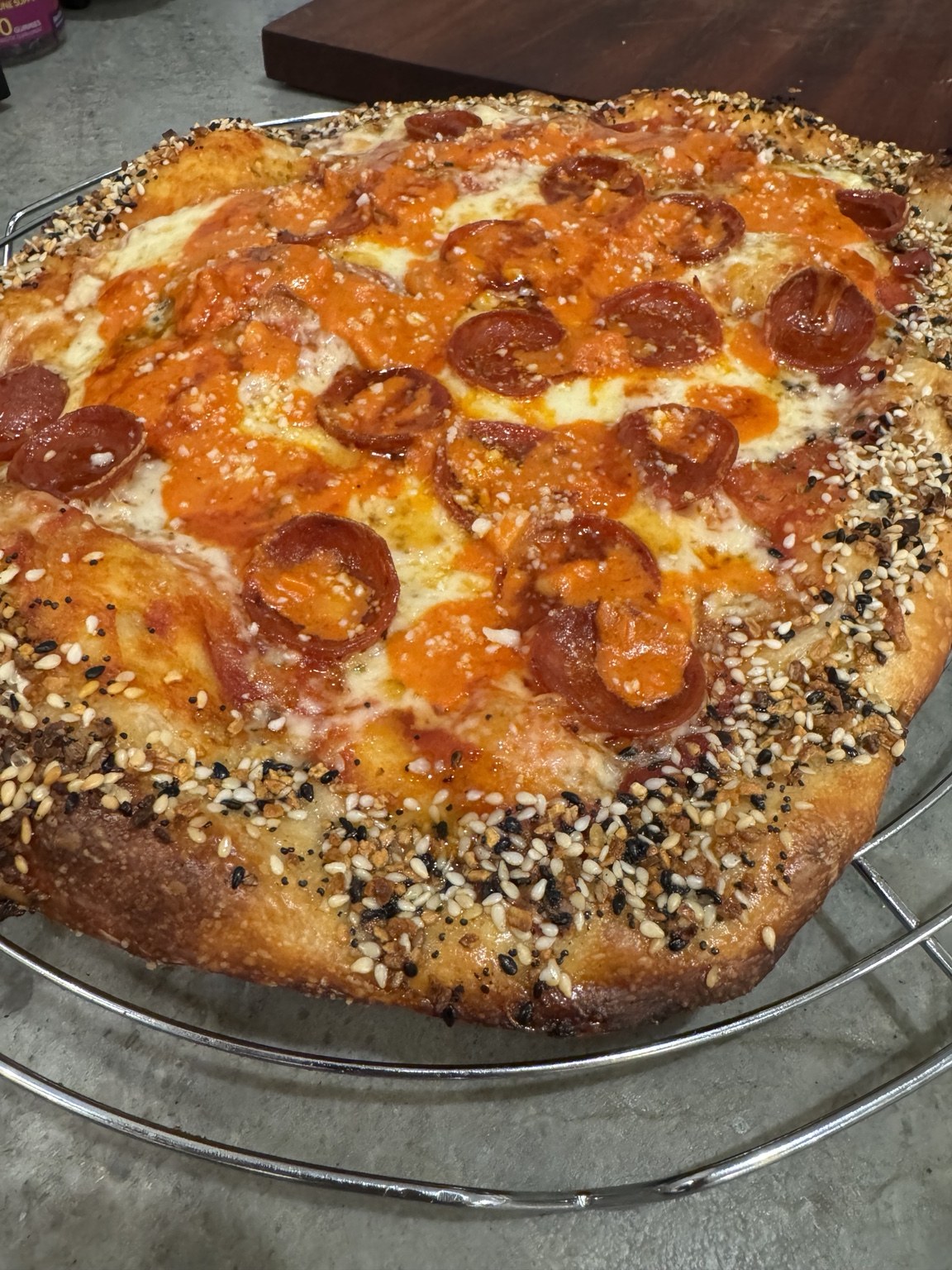
I own the Baking Steel Original and Baking Steel Pro. They are part of the equipment behind Greg’s Pizza & Bagel Joint, and a useful starting point for explaining what a baking surface does.
This guide combines that equipment context with published technical and care information. The goal is to help you choose a setup that makes sense for your kitchen.
What changes when you use steel?
The baking surface stores heat and delivers it to the dough touching it. Steel transfers that heat more readily than the ceramic materials commonly used for pizza stones. That can help a home oven brown the bottom before the toppings spend too long in the heat.
King Arthur explains this distinction in its steel-versus-stone comparison. Faster heat transfer does not mean every pizza needs the same bake time. Thickness, toppings, temperature, and placement still matter.
Ask yourself what is missing from your current bake. If the underside stays pale while the top finishes, the baking surface deserves attention. If the underside already burns, start with your setup before buying something that delivers bottom heat more aggressively.
A practical comparison
| Decision | Pizza steel | Pizza stone |
|---|---|---|
| Bottom browning | Faster heat transfer can help when the bottom lags behind the top. | Less aggressive heat transfer; still useful when thoroughly heated. |
| Handling | Check the exact weight before choosing a size or thickness. | Check both weight and fragility; handle carefully. |
| Care | Carbon steel needs drying and seasoning maintenance. | Care depends on the material; porous cordierite requires a different cleaning approach. |
| Budget | Compare the actual model, delivered price, and fit. | A stone you already own is worth learning to use before replacing it. |
The heat-transfer comparison is supported by King Arthur’s guide; the care differences are covered in Baking Steel’s instructions and Ooni’s stone-care guide.
Measure before you order
Measure the usable oven rack and check the oven manual for rack loading, placement, and clearance requirements. Leave the airflow space required by the oven and baking-surface manufacturers. A surface that crowds the cavity is not a good fit just because the door closes.
For a concrete reference, Baking Steel currently lists its Original at 16×14 inches, ¼ inch thick, and 15 pounds. Those are the Original’s specifications, not specifications for every steel or for the Pro. Confirm the current model details on the manufacturer’s product page.
Think through the whole job: lifting it onto a rack while cold, storing it, and cleaning it. You should be comfortable with the weight before it enters your oven.
Preheat the surface, then balance the bake
The oven’s preheat signal measures the oven’s progress; it does not establish that a thick baking surface is ready. Follow the surface maker’s method. Baking Steel’s current Original instructions call for a 45–60 minute preheat at 500–550°F; use that only when your oven and accessories permit it.
Keep a simple record of the rack position and the top and bottom results. A dark top with a pale base and a scorched base with an unfinished top are different problems. Repeating the same setup with a more expensive surface will not automatically resolve either one.
Use the Home Oven Setup Guide to review your arrangement. For the broader picture—toppings, preheating, baking, and cooling—read How to Get a Crispy Pizza Bottom in a Home Oven.
Have the launch and removal tools ready before heating the oven. Position the surface while cold and allow it to cool fully before moving or cleaning it.
Steel and stone need different care
For its Original, Baking Steel recommends cleaning after cooling, drying thoroughly, and applying a light coat of oil to maintain the seasoning. It allows mild soap when needed and says to keep the steel out of the dishwasher. Follow the current care instructions for your model.
Ooni’s guidance for its cordierite stones emphasizes avoiding soaking, soap, and sudden temperature changes. Let the stone cool and use the cleaning method recommended for that stone. A glazed ceramic product may have different instructions. Read Ooni’s guide before applying steel-cleaning habits to a porous stone.
Do not choose a material whose routine care you are unlikely to follow. The useful purchase is the one you can comfortably keep using.
What if you mostly make pan pizza?
With pan pizza, the pan sits between the dough and the baking surface. Think of the pan and the surface as a combination. Follow the pan manufacturer’s guidance on direct contact with a hot steel or stone, and use a recipe suited to the pan.
It helps to settle the dough quantity before comparing equipment. How Much Pizza Dough Do I Need? explains area scaling, and the Pan-Size Converter handles the calculation. Compare bakes using the same dough, pan, and toppings so you can tell what the surface changed.
Which would I choose?
For a home pizza maker looking to improve a pale underside, I would put a properly sized steel high on the list. If you already like the results from your stone, keep using it. If lifting the steel feels awkward, choose equipment you can handle comfortably.
Browse Greg’s Gear Room for the rest of my equipment context. When you are ready to compare the current Baking Steel options, use my Baking Steel storefront link — affiliate link.
For the first bake on any new surface, write down the result in the Pizza Bake Journal. If the result still needs work, Fix My Pizza can help you organize the next adjustment.